 My Account
 +7 (495) 129 37 00
 st. Derbenevskaya, 9
Dental Implantology
Titanium implant placement into jawbone followed by prosthetics.
Available sections:
Dental Implantology
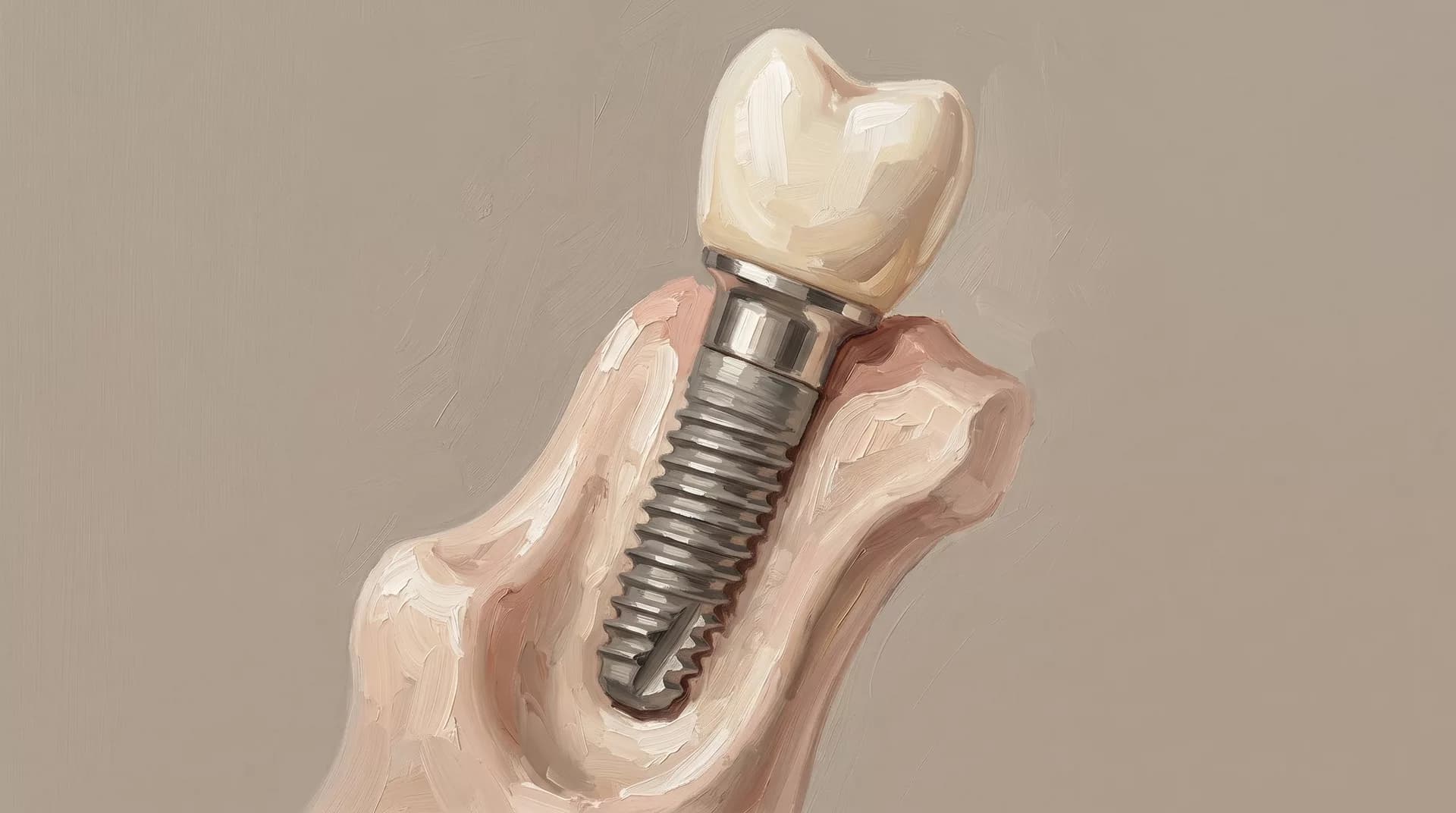
A dental implant is a titanium post placed into the jawbone that serves as an artificial tooth root. A crown is attached to the implant, allowing the restored tooth to function, look, and feel like a natural tooth.
Implant placement is the most reliable and long-lasting method of replacing missing teeth. Unlike a dental bridge, it does not require preparation of adjacent teeth and helps prevent bone loss in the area of the missing tooth.
At Iskusstvo Clinic in Moscow, implant treatment is performed by a maxillofacial surgeon together with a prosthodontist.
Treatment Stages
Consultation and Planning
Cone beam computed tomography (CBCT) of the jaws is performed to assess bone volume and density, as well as the location of nerve canals and maxillary sinuses.
Based on the CT scan, the surgeon and prosthodontist jointly determine the ideal implant position and assess whether bone grafting or sinus augmentation is required.
In some cases, digital planning with fabrication of a surgical guide is used to achieve maximum accuracy during implant placement.
Surgical Stage – Implant Placement
The procedure is performed under local anesthesia or, if desired, with intravenous sedation.
The surgeon prepares an implant bed within the bone, inserts the implant, and closes the gum tissue with sutures.
Placement of a single implant usually takes between 30 and 60 minutes.
If necessary, bone grafting or guided bone regeneration may be performed at the same time.
Osseointegration Period
The implant integrates with the surrounding bone through a process called osseointegration.
This typically takes between two and six months, depending on bone density and the implant location.
Healing is generally faster in the lower jaw, about two to three months, and longer in the upper jaw, approximately four to six months.
During this period, a temporary restoration may be used.
Healing Abutment and Prosthetic Stage
After osseointegration, the surgeon places a healing abutment, a small component that shapes the gum tissue around the implant.
The prosthodontist then takes impressions and fabricates the final crown.
Immediate Implant Placement
In selected cases, an implant can be inserted immediately after tooth extraction.
This is possible when there is no infection, sufficient bone volume is present, and the extraction socket has a favorable configuration.
The advantage is a shorter overall treatment time and fewer surgical procedures.
Implant Placement in Patients with Bone Loss
After tooth extraction, bone tissue gradually decreases in volume.
If several years have passed since tooth loss, the available bone may be insufficient for implant placement.
In these situations, bone grafting or sinus lift surgery for the posterior upper jaw may be performed either before or simultaneously with implant placement.
Implant Systems
The clinic uses implant systems from leading international manufacturers, including:
- Straumann (Switzerland)
- Nobel Biocare (Sweden/USA)
- Dentium (South Korea)
The choice of implant system is discussed with the surgeon and prosthodontist, taking into account the clinical situation and the patient’s preferences.
Rehabilitation
Following implant placement, swelling of the gums may persist for three to five days, and mild discomfort may be present for one to two weeks.
Reduced loading of the implant area is recommended throughout the osseointegration period.
Proper oral hygiene is essential and includes gentle brushing around the implant and the use of an oral irrigator.
Smoking significantly reduces implant survival rates and is strongly discouraged.
Contraindications
Implant placement may be contraindicated in the following situations:
- Uncontrolled diabetes mellitus
- Head and neck cancer treated with radiation therapy
- Decompensated osteoporosis
- Use of bisphosphonate medications
- Active inflammatory periodontal disease
Smoking is considered a relative contraindication because it substantially increases the risk of peri-implantitis.
The final decision is made by the surgeon after a complete examination.
Frequently Asked Questions
How Long Does an Implant Last?
With proper placement, good oral hygiene, and the absence of risk factors, implants can function successfully for decades.
Long-term studies demonstrate high survival rates after ten to fifteen years.
Regular follow-up visits, professional cleanings, and smoking cessation are essential for maintaining long-term success.
Is Implant Placement Painful?
The procedure itself is painless under local anesthesia.
After the anesthesia wears off, mild discomfort may occur for two to three days and is usually controlled with standard pain medication.
Can Implants Be Placed in Patients with Diabetes?
Implant treatment is possible in patients with well-controlled diabetes, generally when HbA1c levels are 7–8% or lower.
These cases require more careful preparation and monitoring.
Implant placement is contraindicated in uncontrolled diabetes.
The decision is made jointly with an endocrinologist.
Is an Implant Visible on an X-ray?
Yes. On radiographs, an implant appears as a metallic post.
This is completely normal and does not interfere with the assessment of adjacent teeth.
Titanium implants are MRI-compatible and do not create significant artifacts during magnetic resonance imaging.
Book a Consultation
Book a consultation. The surgeon and prosthodontist will assess your situation together and develop an individual treatment plan.
OUR SPECIALISTS
A team that continues the traditions of Professor A.I. Nerobeev's school. Our specialists not only practice but also teach, developing unique techniques in reconstructive and aesthetic medicine.




Leave your number and we will contact you