 My Account
 +7 (495) 129 37 00
 st. Derbenevskaya, 9
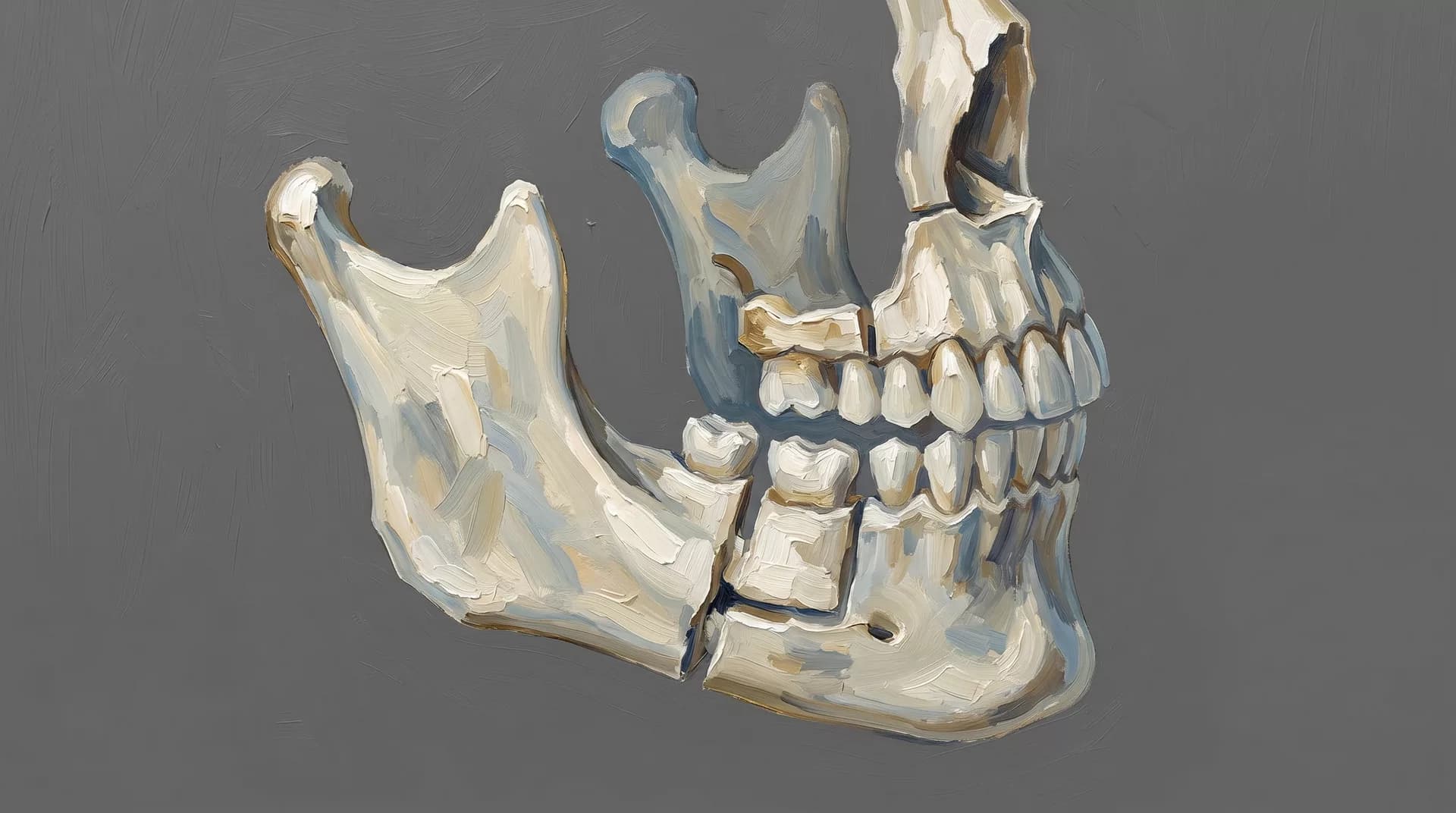
Osteotomy of Lower and Upper Jaw
Surgical bone cutting and repositioning of jaws fixed with titanium plates.
Available sections:
Osteotomy of the Lower and Upper Jaw
Osteotomy, from the Greek osteon, meaning bone, and tomos, meaning incision, is a surgical procedure in which a bone is cut, moved into a new position, and fixed. In orthognathic surgery, osteotomy of the lower or upper jaw is the main tool for correcting skeletal bite anomalies. At Iskusstvo Clinic in Moscow, these operations are performed through intraoral approaches, without facial incisions, under general anesthesia.
Lower Jaw Osteotomy
The most commonly used technique is sagittal split ramus osteotomy, or SSRO. The surgeon cuts the ramus of the lower jaw so that two fragments are formed and can “slide” relative to each other. This allows the lower jaw to be moved forward, backward, rotated, or tilted, depending on the planned position.
After movement, the fragments are fixed with titanium screws or plates.
Another technique is intraoral vertical ramus osteotomy, or IVRO. It is used mainly in cases of significant backward repositioning of the lower jaw and in temporomandibular joint pathology.
Upper Jaw Osteotomy
The standard technique is Le Fort I osteotomy. The upper jaw is separated from the skull base with a horizontal cut above the roots of the teeth and moved in the required direction: forward, backward, upward, or downward. After movement, it is fixed with titanium plates.
This method allows correction of both the anteroposterior and vertical position of the upper jaw.
In cases of significant upper jaw width anomalies, surgically assisted rapid palatal expansion, or SARPE, is used. This involves gradual expansion with a distractor.
Bimaxillary Osteotomy
In combined anomalies of both jaws, operations are performed simultaneously. Bimaxillary surgery makes it possible to distribute the movements optimally between the two jaws, achieve a better aesthetic and functional result, and reduce the amount of movement required for each jaw.
The duration of such an operation ranges from 3 to 5 hours.
Course of Surgery
All approaches are intraoral, so no facial scars remain. The operation is performed under general anesthesia with nasotracheal intubation: the tube is passed through the nose so that it does not interfere with work in the oral cavity.
During the operation, the surgeon uses pre-made surgical guides, or splints, which help position the jaws precisely in the planned position.
After the operation is completed, the lower and upper jaws are temporarily fixed to each other with ligatures or special elastic bands for a period ranging from several days to 2 weeks, depending on the surgical technique.
Rehabilitation
Hospitalization usually lasts 3–5 days. Facial swelling in the first days after surgery may be significant, and this is normal. It decreases actively by the end of the second week and resolves completely within 3–4 months.
A soft, gentle diet is required for 6–8 weeks. Numbness of the lower lip and chin may occur due to stretching of the inferior alveolar nerve. In most cases, sensitivity recovers within several months.
Postoperative orthodontic treatment is usually resumed 4–6 weeks after surgery and continues for another 3–6 months.
A follow-up CT scan is performed after 3–4 months.
Contraindications
Contraindications include incomplete growth of the facial skeleton, severe systemic diseases, uncorrectable blood clotting disorders, and active inflammatory processes in the oral cavity.
Smoking slows healing, so it is recommended to stop smoking at least 4 weeks before surgery.
Frequently Asked Questions
Will There Be Scars After Surgery?
No visible facial scars remain, because all incisions are made inside the oral cavity. Scars form on the mucosa, but they are not visible externally.
Will the Lower Lip Become Numb After Surgery?
Temporary numbness of the lower lip and chin after lower jaw osteotomy is common and is associated with stretching of the inferior alveolar nerve.
In most cases, sensitivity recovers within 3–12 months. Persistent numbness is much less common, and the surgeon always discusses this risk during the consultation.
Can I Eat After Surgery?
During the first 6–8 weeks, only soft and liquid foods are allowed. This is important for proper bone healing.
After food restrictions are lifted, chewing is restored gradually.
How Quickly Will Facial Swelling Go Down?
About 50% of the swelling resolves during the first 2 weeks. The remaining swelling gradually decreases over 3–4 months.
Cold compresses are used during the first days, and lymphatic drainage massage may be recommended after the incisions have healed to speed up recovery.
Book a Consultation
Book a consultation. The surgeon will explain which type of osteotomy is suitable in your case and what results can be expected.
OUR SPECIALISTS
A team that continues the traditions of Professor A.I. Nerobeev's school. Our specialists not only practice but also teach, developing unique techniques in reconstructive and aesthetic medicine.


Leave your number and we will contact you